Of all the contamination control products used at cleanroom entry points, the sticky mat is perhaps the most underappreciated. It requires no training, no utilities, and no maintenance — yet it captures thousands of particles per square centimetre from footwear soles and equipment wheels before they enter the controlled area.
How Sticky Mats Work
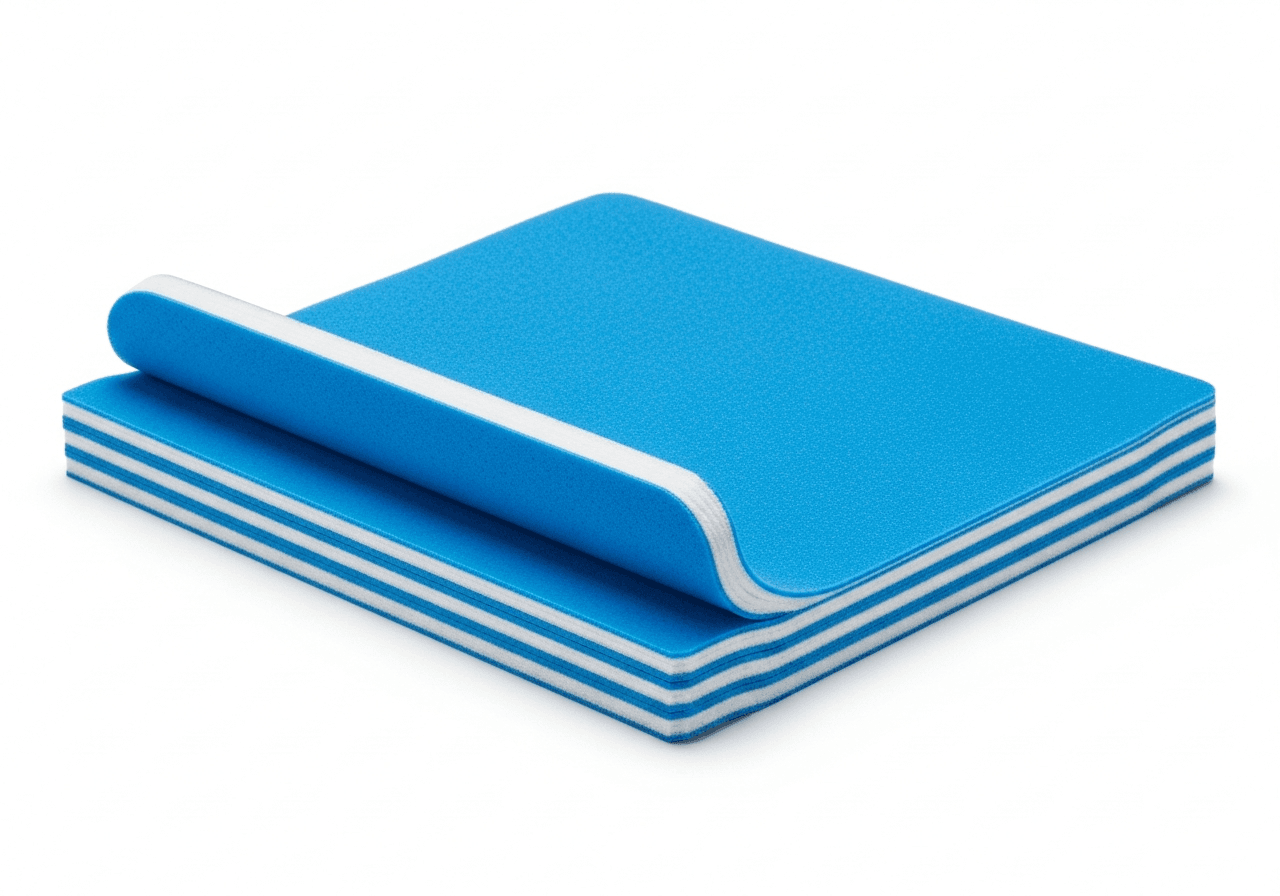
A cleanroom sticky mat consists of multiple layers of high-tack polyethylene film, each coated with a pressure-sensitive adhesive. When personnel or equipment cross the mat, the adhesive traps particles from the contact surface. When the top layer is visibly contaminated, it is peeled away to reveal a fresh adhesive layer beneath — a process that takes seconds and requires no tools.
A standard mat contains between 30 and 60 peel-off layers, giving it a long service life relative to its per-unit cost. High-quality mats use a clean-peel adhesive that does not leave residue on shoes or floors when layers are removed.
Where to Place Sticky Mats
Sticky mats are most effective when placed at every entry point to a controlled zone, in the correct sequence within the gowning area. Recommended placement:
- At the entrance to the gowning room — to reduce contamination brought from the corridor
- At the cleanroom door — as the final barrier before entry
- At every equipment entry hatch or airlock — including trolley access points
- In ante-rooms and airlocks — where personnel cross between pressure zones
Choosing the Right Size and Tack Level
Sticky mats are available in a range of standard sizes — typically 45×90 cm (18×36 in) for personnel entry and 60×115 cm (24×45 in) for equipment access. The tack level (adhesive strength) should be matched to the application: a higher-tack mat captures more particles but can be uncomfortable underfoot or leave residue if not formulated correctly. Medical-grade polyethylene film and controlled-tack adhesive are the marks of a quality mat.
Common Mistakes to Avoid
- Leaving a heavily soiled top layer in place — replace when visibly dirty, not on a fixed schedule
- Placing the mat too far from the door — the last few steps before entry undo its benefit
- Using mats without shoe covers — mats complement, not replace, footwear controls
- Choosing mats with residue-leaving adhesive — this can itself become a contamination source
- Using undersized mats — personnel must step fully onto the mat with both feet
Vaishnavi Trading supplies multi-layer peel-off sticky mats in multiple dimensions, suitable for pharmaceutical cleanrooms, hospital operating areas, and electronics manufacturing facilities. Contact us for bulk pricing.
Sticky Mats as Part of a Layered Entry Strategy
No single contamination control measure is sufficient on its own. Sticky mats work best as part of a layered entry strategy that includes disposable shoe covers applied in the gowning room, a sticky mat at the gowning room exit, autoclavable shoes changed at the cleanroom door, and a final sticky mat at the cleanroom entrance. Together, this sequence provides multiple overlapping particle barriers — the principle of defence in depth applied to contamination control.